
Crochet flowers and bouquets are the coziest way to turn a few balls of cotton yarn into flowers that never wilt. In this free tutorial you get five complete patterns written out in text and shown with photos: a daisy, tulips, the Lily A, and two different roses. Every pattern works on its own, and together they make a full handmade bouquet, which is why crochet flowers and bouquets are so popular for Mother’s Day, Valentine’s Day, weddings, birthdays and home decor.
Quick answer: what are crochet flowers and bouquets?
Crochet flowers and bouquets are handmade flowers worked in yarn (usually cotton) with a crochet hook, then attached to floral wire or wooden skewers and tied into a bouquet. They are also called forever flowers because they last for years, need no water and can be customized in any color.
In this guide
1. Why make crochet flowers and bouquets
2. Materials and abbreviations
3. Daisy pattern
4. Tulips pattern
5. Lily A pattern
6. Rose type 1 pattern
7. Rose type 2 pattern
8. How to arrange your bouquet
9. Pro tips
10. FAQ
Why Make Crochet Flowers and Bouquets?
There are good reasons crochet flowers and bouquets have taken over Pinterest, TikTok and craft fairs. A crochet bouquet is a gift that lasts, it uses small amounts of leftover yarn, and each flower is a short project you can finish in an evening. If you already know the basics (magic ring, single crochet, half double crochet and double crochet), you can start making crochet flowers and bouquets today.
- They last forever. Unlike fresh flowers, crochet flowers do not wilt, so a bouquet becomes a keepsake.
- Perfect handmade gifts. Crochet flowers and bouquets suit Mother’s Day, Valentine’s Day, teacher gifts, bridesmaid bouquets and wedding decor.
- Beginner friendly. Daisies and tulips are quick, while the lily and roses give experienced crocheters something to enjoy.
- Totally customizable. Change the yarn colors to match a room, a season or a wedding palette.
Materials and Abbreviations for Crochet Flowers and Bouquets
What you need
- Cotton yarn in flower colors (white, yellow, orange, red, pink) plus green for leaves and stems. Cotton keeps petals crisp.
- Crochet hooks: choose a size that gives a tight, firm fabric for your yarn. The Lily A pattern uses a size B (1.90 mm) hook with Cotton 8 thread.
- Floral wire (0.8 mm, 0.6 mm and 0.3 mm for the lily) or wooden sticks for the stems.
- Green floral tape or extra green yarn to wrap the stems.
- Craft glue to attach petals, and fibrefill (or cotton) to stuff the daisy center.
- Optional: violet gems and green seed beads for the lily, and blush or makeup to shade the pink rose.
- Scissors, a yarn needle and stitch markers.
Abbreviations used in these crochet flowers and bouquets patterns
| Abbreviation | Meaning |
|---|---|
| R / Rnd | Round or row |
| ch | Chain |
| sl st / sl / st | Slip stitch |
| sc | Single crochet |
| hdc | Half double crochet |
| dc | Double crochet |
| tc | Triple crochet |
| inc | Increase (2 stitches in the same stitch) |
| sk | Skip |
| rep | Repeat |
| FO | Fasten off |
| w | Marker used in the original chart at the tip or turning point of a petal or leaf; follow it as written |
These crochet flowers and bouquets patterns use US crochet terms. Worked over wire, petals and leaves keep their shape, which gives your bouquet a realistic look.
Daisy: The Easiest of All Crochet Flowers and Bouquets
The daisy is the best starting point for crochet flowers and bouquets. It is a simple two-part flower: a small round center and a ring of 12 petals.
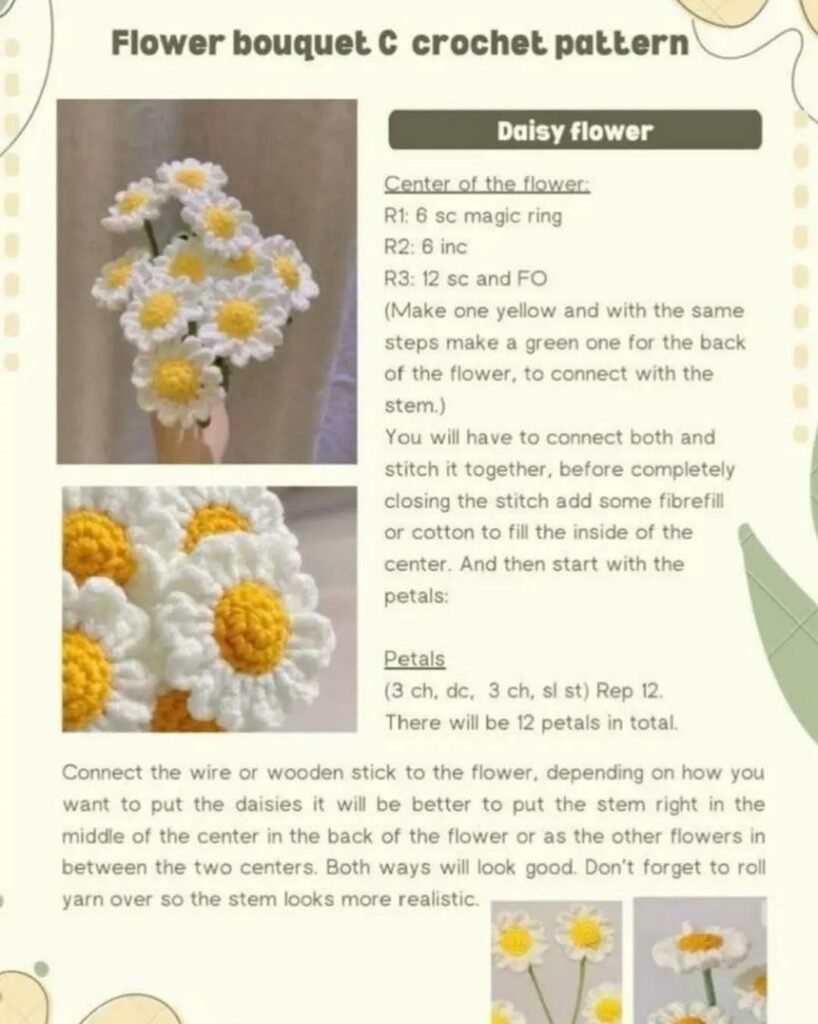
Center of the flower
R1: 6 sc in a magic ring
R2: 6 inc
R3: 12 sc and FO
Make one center in yellow. With the same steps, make a green one for the back of the flower, which connects to the stem.
Connect both pieces and stitch them together. Before completely closing the stitching, add some fibrefill or cotton to fill the inside of the center. Then start the petals.
Petals
(3 ch, dc, 3 ch, sl st) Rep 12. There will be 12 petals in total.
Assembly
Connect the wire or wooden stick to the flower. Depending on how you want to arrange the daisies, put the stem right in the middle of the center at the back of the flower, or in between the two centers like the other flowers. Both ways look good. Do not forget to roll yarn over the stem so it looks more realistic.
Tulips: Colorful Crochet Flowers and Bouquets in Minutes
Tulips add bold color to any crochet bouquet. Each tulip uses three small petals, three big petals and a long leaf, all worked over wire.
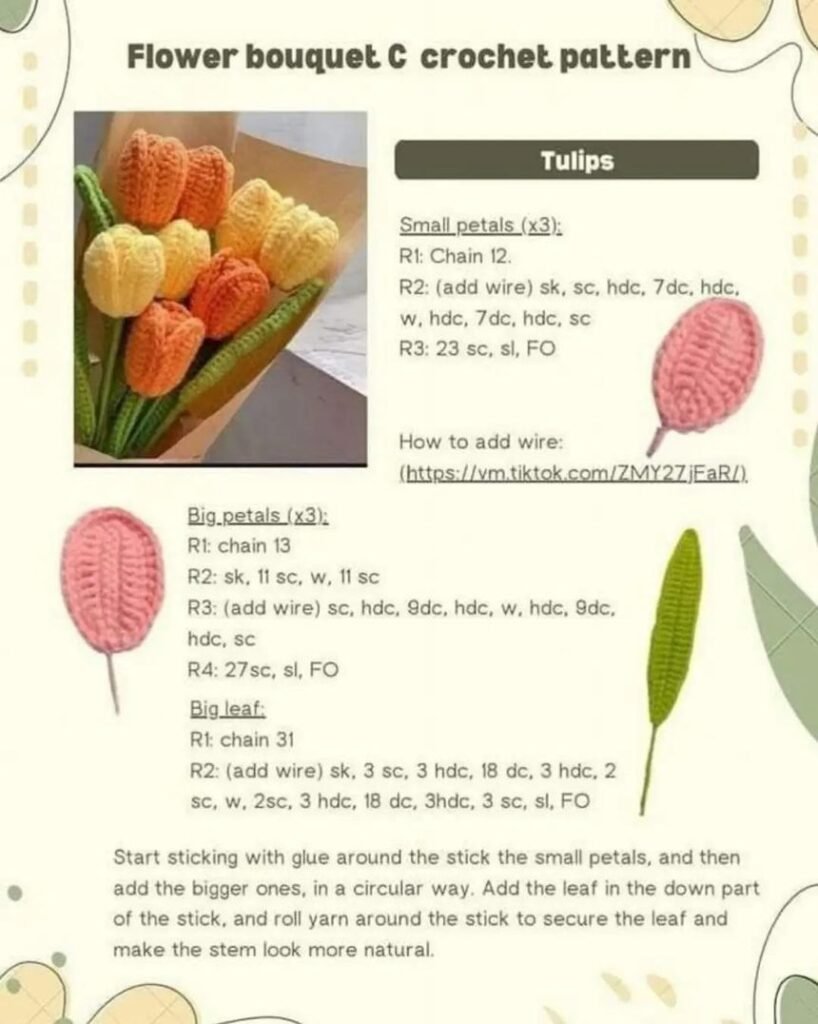
Small petals (x3)
R1: Chain 12
R2: (add wire) sk, sc, hdc, 7 dc, hdc, w, hdc, 7 dc, hdc, sc
R3: 23 sc, sl, FO
How to add wire: the original pattern links to a short video tutorial at vm.tiktok.com/ZMY27jFaR.
Big petals (x3)
R1: Chain 13
R2: sk, 11 sc, w, 11 sc
R3: (add wire) sc, hdc, 9 dc, hdc, w, hdc, 9 dc, hdc, sc
R4: 27 sc, sl, FO
Big leaf
R1: Chain 31
R2: (add wire) sk, 3 sc, 3 hdc, 18 dc, 3 hdc, 2 sc, w, 2 sc, 3 hdc, 18 dc, 3 hdc, 3 sc, sl, FO
Assembly
Start sticking the small petals around the stick with glue, then add the bigger ones in a circular way. Add the leaf at the lower part of the stick, and roll yarn around the stick to secure the leaf and make the stem look more natural.
Lily A: An Elegant Pattern for Crochet Flowers and Bouquets
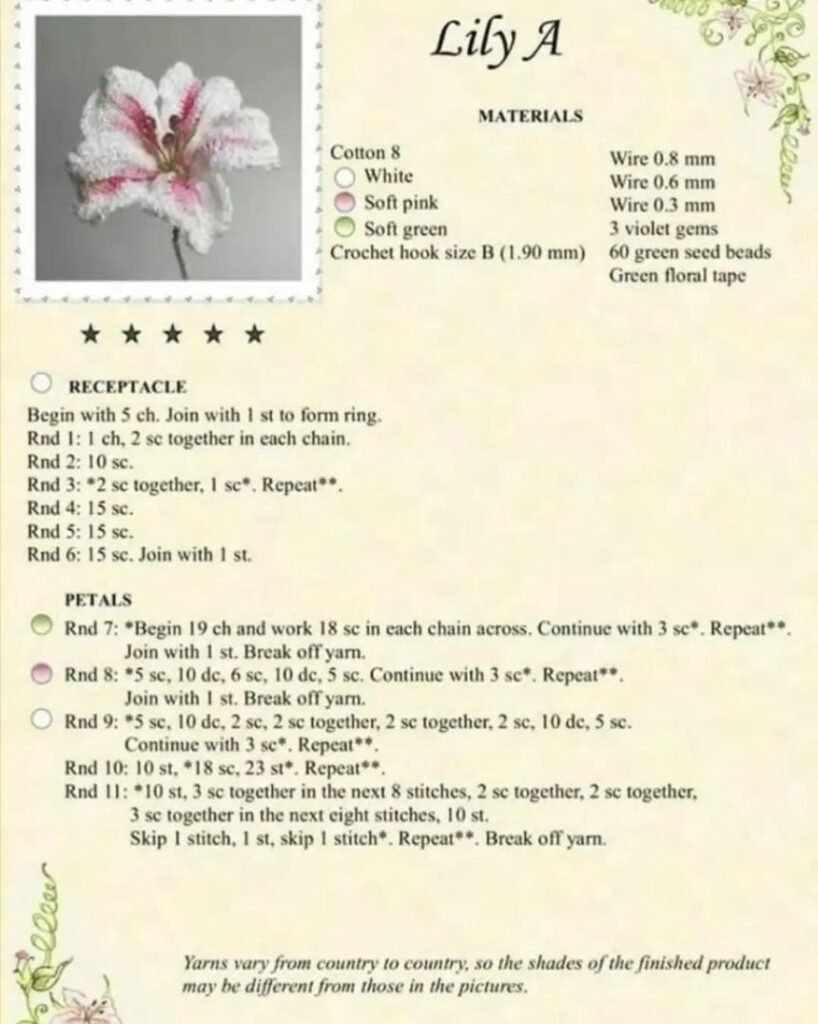
The Lily A is the showpiece of this collection of crochet flowers and bouquets. It is worked in fine cotton with a small hook, so it takes patience, and the result looks remarkably close to a real lily.
Materials
Cotton 8 in white, soft pink and soft green. Crochet hook size B (1.90 mm). Wire 0.8 mm, 0.6 mm and 0.3 mm. 3 violet gems, 60 green seed beads and green floral tape.
Receptacle
Begin with 5 ch. Join with 1 st to form a ring.
Rnd 1: 1 ch, 2 sc together in each chain.
Rnd 2: 10 sc.
Rnd 3: *2 sc together, 1 sc*. Repeat**.
Rnd 4: 15 sc.
Rnd 5: 15 sc.
Rnd 6: 15 sc. Join with 1 st.
Petals
Rnd 7 (soft green): *Begin 19 ch and work 18 sc in each chain across. Continue with 3 sc*. Repeat**. Join with 1 st. Break off yarn.
Rnd 8 (soft pink): *5 sc, 10 dc, 6 sc, 10 dc, 5 sc. Continue with 3 sc*. Repeat**. Join with 1 st. Break off yarn.
Rnd 9 (white): *5 sc, 10 dc, 2 sc, 2 sc together, 2 sc together, 2 sc, 10 dc, 5 sc. Continue with 3 sc*. Repeat**.
Rnd 10: 10 st, *18 sc, 23 st*. Repeat**.
Rnd 11: *10 st, 3 sc together in the next 8 stitches, 2 sc together, 2 sc together, 3 sc together in the next eight stitches, 10 st. Skip 1 stitch, 1 st, skip 1 stitch*. Repeat**. Break off yarn.
Note from the original pattern: yarns vary from country to country, so the shades of your finished flower may differ from the pictures. The wires, gems, seed beads and floral tape listed above are used to build the stamens and wrap the stem.
Rose Type 1: Classic Red Roses for Crochet Flowers and Bouquets
No bouquet is complete without roses. This first rose is made from one long ruffled strip that you roll up into a blossom, which is why it is a favorite in crochet flowers and bouquets for Valentine’s Day.
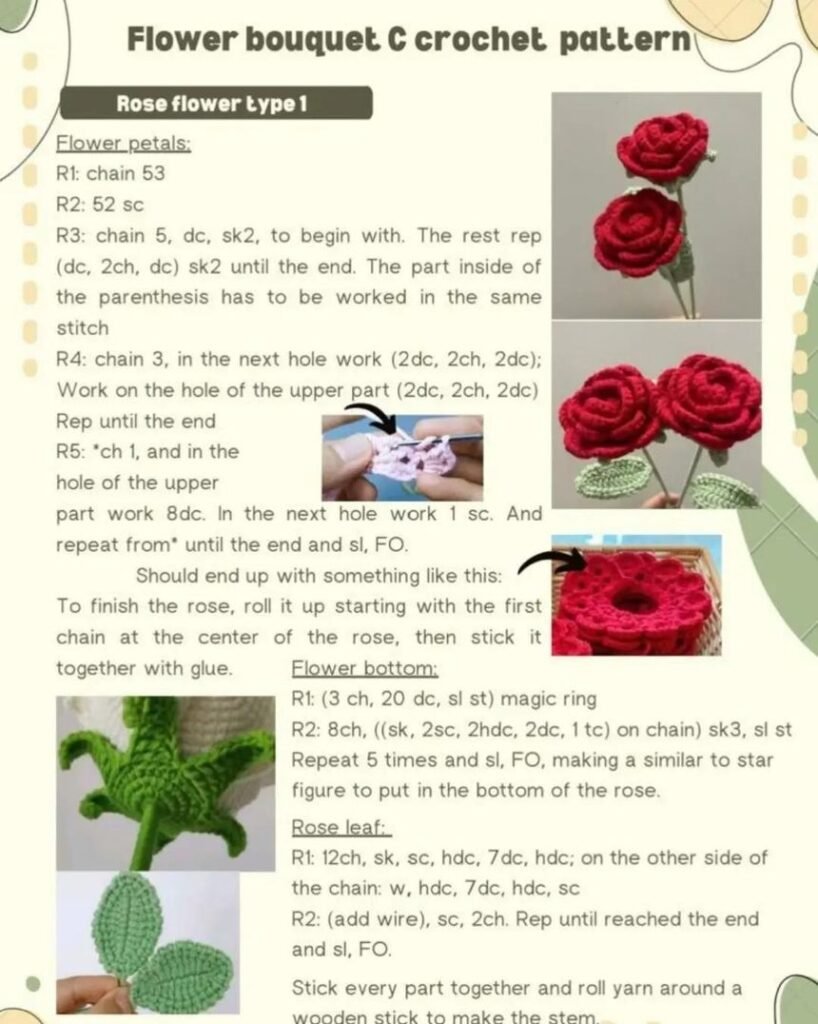
Flower petals
R1: Chain 53
R2: 52 sc
R3: Chain 5, dc, sk 2, to begin with. The rest: rep (dc, 2 ch, dc), sk 2 until the end. The part inside the parenthesis has to be worked in the same stitch.
R4: Chain 3, in the next hole work (2 dc, 2 ch, 2 dc). Work in the hole of the upper part (2 dc, 2 ch, 2 dc). Rep until the end.
R5: *Ch 1, and in the hole of the upper part work 8 dc. In the next hole work 1 sc. Repeat from * until the end, then sl, FO.
To finish the rose, roll it up starting with the first chain at the center of the rose, then stick it together with glue.
Flower bottom
R1: (3 ch, 20 dc, sl st) in a magic ring
R2: 8 ch, ((sk, 2 sc, 2 hdc, 2 dc, 1 tc) on chain) sk 3, sl st. Repeat 5 times and sl, FO, making a star-like figure to put at the bottom of the rose.
Rose leaf
R1: 12 ch, sk, sc, hdc, 7 dc, hdc; on the other side of the chain: w, hdc, 7 dc, hdc, sc
R2: (add wire), sc, 2 ch. Rep until you reach the end and sl, FO.
Stick every part together and roll yarn around a wooden stick to make the stem.
Rose Type 2: Soft Pink Petal Rose for Crochet Flowers and Bouquets
The second rose is built from separate small, midi and big petals, which gives it a fuller, more realistic shape. It is a lovely choice when your crochet flowers and bouquets need a softer, romantic look.
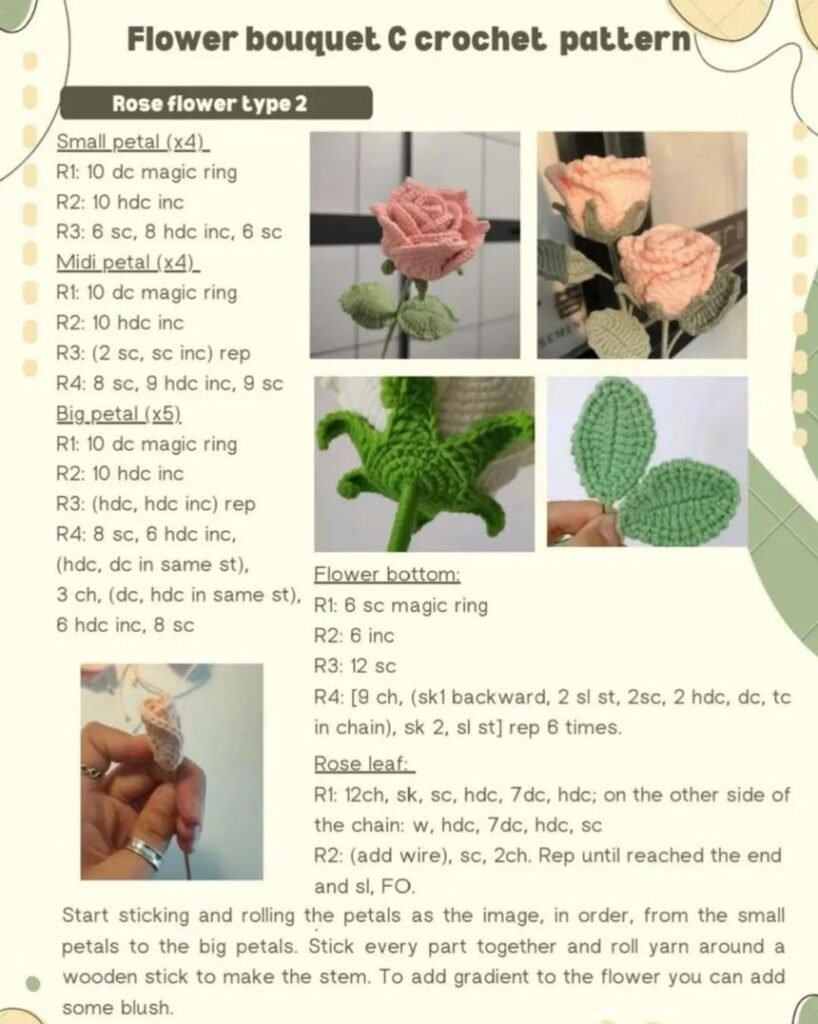
Small petal (x4)
R1: 10 dc in a magic ring
R2: 10 hdc inc
R3: 6 sc, 8 hdc inc, 6 sc
Midi petal (x4)
R1: 10 dc in a magic ring
R2: 10 hdc inc
R3: (2 sc, sc inc) rep
R4: 8 sc, 9 hdc inc, 9 sc
Big petal (x5)
R1: 10 dc in a magic ring
R2: 10 hdc inc
R3: (hdc, hdc inc) rep
R4: 8 sc, 6 hdc inc, (hdc, dc in same st), 3 ch, (dc, hdc in same st), 6 hdc inc, 8 sc
Flower bottom
R1: 6 sc in a magic ring
R2: 6 inc
R3: 12 sc
R4: [9 ch, (sk 1 backward, 2 sl st, 2 sc, 2 hdc, dc, tc in chain), sk 2, sl st] rep 6 times.
Rose leaf
R1: 12 ch, sk, sc, hdc, 7 dc, hdc; on the other side of the chain: w, hdc, 7 dc, hdc, sc
R2: (add wire), sc, 2 ch. Rep until you reach the end and sl, FO.
Assembly
Start sticking and rolling the petals as in the photo, in order, from the small petals to the big petals. Stick every part together and roll yarn around a wooden stick to make the stem. To add a gradient to the flower, you can add some blush.
How to Arrange Crochet Flowers and Bouquets
Once your flowers are finished, arranging them is the fun part. Follow these steps to turn single stems into a bouquet:
- Choose a palette. Two or three flower colors plus green leaves look balanced.
- Start with a focal flower. Place a rose or the lily in the center.
- Build outward. Add tulips and daisies around it, with taller stems in the middle and shorter stems at the edges.
- Add leaves. Tuck rose leaves and tulip leaves between the blooms to fill gaps.
- Secure the stems. Wrap them together with floral tape or green yarn.
- Finish. Wrap the bouquet in kraft paper or tissue and tie a ribbon bow.
Pro Tips for Beautiful Crochet Flowers and Bouquets
- Use cotton yarn. It gives the sharpest petal edges and the best structure for crochet flowers and bouquets.
- Crochet tightly. Go down a hook size if petals look floppy.
- Work over wire where the pattern says so. This lets you bend petals and leaves into natural curves.
- Roll yarn over every stem. It hides the wire and makes the stem look real.
- Use blush for shading. A little makeup blush gives roses a natural gradient.
- Mix flower types. A combination of daisies, tulips, roses and a lily makes crochet flowers and bouquets look professional.
- Try other colors. The same patterns work in pastel shades for weddings or deep reds for Valentine’s Day.
Crochet Flowers and Bouquets: Frequently Asked Questions
How to make a crochet flower bouquet easy?
Start with the simplest flowers, pick one yarn type (cotton works best) and make every stem the same way. Crochet 5 to 7 daisies or tulips from the patterns above, add floral wire or a wooden skewer to each stem, wrap the stems with matching green yarn, then tie everything together with ribbon or kraft paper. Following this method, crochet flowers and bouquets become a relaxed one-weekend project.What is the easiest flower to crochet?
The daisy is the easiest flower to crochet. It uses only a 6-stitch magic ring, a 12-stitch center and a repeating petal (3 ch, dc, 3 ch, sl st) worked 12 times. Tulips come second because their petals are small flat ovals. If you are new to crochet flowers and bouquets, begin with the daisy.How many flowers should be in a crochet bouquet?
A small bouquet looks full with 5 to 7 flowers, a medium gift bouquet usually uses 10 to 12, and a statement bouquet uses 15 to 25. Odd numbers and mixed flower types look more natural. When you plan crochet flowers and bouquets as gifts, add a few extra leaves to fill the gaps.What are some of the best crochet flowers?
The best crochet flowers for bouquets are daisies, tulips, roses and lilies, which are exactly the five designs in this tutorial (daisy, tulips, Lily A and two rose types). They look realistic, hold their shape on wire stems and mix well together in crochet flowers and bouquets.
Final Thoughts on Crochet Flowers and Bouquets
With these five free patterns you can make a daisy, tulips, a lily and two kinds of roses, and combine them into a bouquet that lasts forever. Start with the daisy if you are new to crochet flowers and bouquets, then work your way up to the lily. Save this post, share it with a fellow crocheter, and tell us in the comments which flower you made first. Happy crocheting!


